# KMS Performance Comparison
**Versions**: `v5.29.0`
**Generated**: 2026-10-13
---
## Benchmark Environment
| Field | Value |
|---|---|
| Date | 2026-10-13 14:55:31 UTC |
| HSM backend | luna |
| HSM | Luna 1 — firmware 7.8.5 ([details](../luna_hsms.md)) |
| Command | `mise run bench:hsm --delegated --hsm-model luna` |
| Build | release / non-fips |
| HTTP workers (Actix-web) | 32 |
| Database | SQLite (temporary, single benchmark run) |
| CPU | Intel(R) Xeon(R) Silver 4210R CPU @ 2.40GHz @ 2,400 MHz |
| CPU cores | 8 physical / 8 logical (HT) |
| RAM | 15.6 GB |
| OS | Debian GNU/Linux 13 (trixie) |
| Kernel | 6.12.111+deb13-amd64 |
### Load test parameters
| Parameter | Value |
|---|---|
| Mode | sign-verify |
| Protocols | all |
| Measurement window | 20 s per concurrency level |
| Concurrency levels | 1,16,32,64,96 |
| Warm-up | 5 s |
| Cooldown between levels | 2 s |
### CPU detail (`lscpu`)
```text
Architecture: x86_64
CPU op-mode(s): 32-bit, 64-bit
Address sizes: 45 bits physical, 48 bits virtual
Byte Order: Little Endian
CPU(s): 8
On-line CPU(s) list: 0-7
Vendor ID: GenuineIntel
Model name: Intel(R) Xeon(R) Silver 4210R CPU @ 2.40GHz
CPU family: 6
Model: 85
Thread(s) per core: 1
Core(s) per socket: 8
Socket(s): 1
Stepping: 7
BogoMIPS: 4800.00
Flags: fpu vme de pse tsc msr pae mce cx8 apic sep mtrr pge mca cmov pat pse36 clflush mmx fxsr sse sse2 ss ht syscall nx pdpe1gb rdtscp lm constant_tsc arch_perfmon nopl xtopology tsc_reliable nonstop_tsc cpuid tsc_known_freq pni pclmulqdq ssse3 fma cx16 pcid sse4_1 sse4_2 x2apic movbe popcnt tsc_deadline_timer aes xsave avx f16c rdrand hypervisor lahf_lm abm 3dnowprefetch ssbd ibrs ibpb stibp ibrs_enhanced fsgsbase tsc_adjust bmi1 avx2 smep bmi2 invpcid avx512f avx512dq rdseed adx smap clflushopt clwb avx512cd avx512bw avx512vl xsaveopt xsavec xgetbv1 xsaves arat pku ospke avx512_vnni md_clear flush_l1d arch_capabilities
Hypervisor vendor: VMware
Virtualization type: full
L1d cache: 256 KiB (8 instances)
L1i cache: 256 KiB (8 instances)
L2 cache: 8 MiB (8 instances)
L3 cache: 13.8 MiB (1 instance)
NUMA node(s): 1
NUMA node0 CPU(s): 0-7
Vulnerability Gather data sampling: Unknown: Dependent on hypervisor status
Vulnerability Indirect target selection: Mitigation; Aligned branch/return thunks
Vulnerability Itlb multihit: KVM: Mitigation: VMX unsupported
Vulnerability L1tf: Not affected
Vulnerability Mds: Not affected
Vulnerability Meltdown: Not affected
Vulnerability Mmio stale data: Vulnerable: Clear CPU buffers attempted, no microcode; SMT Host state unknown
Vulnerability Reg file data sampling: Not affected
Vulnerability Retbleed: Mitigation; Enhanced IBRS
Vulnerability Spec rstack overflow: Not affected
Vulnerability Spec store bypass: Mitigation; Speculative Store Bypass disabled via prctl
Vulnerability Spectre v1: Mitigation; usercopy/swapgs barriers and __user pointer sanitization
Vulnerability Spectre v2: Mitigation; Enhanced / Automatic IBRS; IBPB conditional; PBRSB-eIBRS SW sequence; BHI SW loop, KVM SW loop
Vulnerability Srbds: Not affected
Vulnerability Tsa: Not affected
Vulnerability Tsx async abort: Not affected
Vulnerability Vmscape: Not affected
```
---
## Architecture
```mermaid
graph TB
subgraph cli["Local: ckms CLI"]
ckms["ckms bench --hsm"]
end
subgraph srv["Local KMS Server"]
kmip["KMIP 2.1
(HTTP)"]
oracle["CryptoOracle
(HSM Router)"]
end
subgraph hsm["luna"]
pkcs11["PKCS#11 Slot"]
hsm_keys["ECDSA
(HSM-resident)"]
end
ckms -->|HTTP| kmip
kmip --> oracle
oracle -->|C_Sign| pkcs11
pkcs11 --> hsm_keys
style ckms fill:#4A90E2
style kmip fill:#7ED321
style oracle fill:#FF6B6B
style pkcs11 fill:#BD10E0
```
**Components**:
- **ckms**: Concurrent load generator (`mise run bench:hsm --delegated --hsm-model luna`)
- **KMIP Endpoint**: HTTP protocol handler
- **CryptoOracle**: Routes crypto ops directly to luna (no software fallback)
- **PKCS#11 Slot**: luna engine for C_Sign operations
- **HSM-Resident Keys**: Keys generated on and never leave hardware
---
## Protocols
This report benchmarks cryptographic operations delegated to an HSM (luna) via the KMS `CryptoOracle`, exercised over a single wire protocol: **ttlv-json**.
| Protocol | Transport | Encoding | Endpoint | Description |
|---|---|---|---|---|
| **ttlv-json** | HTTP/1.1 | KMIP 2.1 JSON-TTLV | `POST /kmip/2_1` | Primary interoperability protocol — any KMIP 2.1 compliant client can use it |
**KMIP TTLV** (Tag-Type-Length-Value) is the native encoding of the KMIP 2.1 standard (OASIS KMIP Spec v2.1, §9.1). The **JSON** variant wraps every field in a `{"tag": …, "type": …, "value": …}` JSON object and base64-encodes binary values.
**ttlv-bytes is not benchmarked here.** Measuring it would require running it either against the same HSM-resident key/token as the ttlv-json sweep (strictly after it completes) or on a fresh token started specifically for that purpose. The former was tried first and rejected: cumulative luna token load from the preceding ttlv-json sweep contaminated every ttlv-bytes measurement, making ttlv-json appear *faster* than ttlv-bytes in every single operation — the opposite of the software baseline (where ttlv-bytes is consistently faster, as expected, since it skips JSON parsing). Rather than publish numbers that are measurement artefacts of test ordering, ttlv-bytes is omitted from this report until the harness can measure both protocols under equivalent conditions (e.g. independent tokens per protocol).
**JOSE is not benchmarked here.** The JOSE REST key-creation endpoint (`POST /v1/crypto/keys`) has no parameter to request a caller-chosen `kid`, and HSM-resident key delegation requires the client to choose the `hsm::::` unique identifier up front (the HSM has no server-assigned ID scheme) — so an HSM-resident key cannot be created through the JOSE endpoints at all.
---
## Benchmark Methodology
### HSM delegation model
Every operation in this report is executed against an `hsm::::` unique identifier. The KMS server routes both key generation (`Create`/`CreateKeyPair`) and cryptographic operations (`Encrypt`/`Sign`) for such keys to the HSM's `CryptoOracle` (PKCS#11) on luna instead of executing them in KMS software — the benchmarked latency/throughput is therefore dominated by the PKCS#11 round-trip to the HSM, not by in-process OpenSSL.
> **HSM Backend:** luna (hardware/appliance HSM backend).
### Algorithm coverage and luna constraints
Operations benchmarked in this scenario:
| Category | Algorithms covered | Notes |
|---|---|---|
| Sign | ECDSA P-256 | Prehashed message digest |
### Payload sizes
All encrypt benchmarks use a **64-byte** fixed-size random payload (128 bytes for AES-CBC/PKCS1v15, which pad to a whole block); all sign benchmarks use a **32-byte** fixed-size message (or, for prehashed ECDSA, a 32-byte SHA-256 digest of that same message).
### Why ttlv-json only (no ttlv-bytes)
An earlier version of this report benchmarked both `ttlv-json` and `ttlv-bytes` for every HSM-delegated operation, sharing one HSM-resident key between the two protocol variants and measuring `ttlv-json`'s full concurrency sweep before `ttlv-bytes`'s. Every single result inverted the expected direction — `ttlv-json` appeared *faster* than `ttlv-bytes`, the opposite of the software baseline (where binary TTLV is consistently faster, since it skips JSON parsing). This report therefore benchmarks `ttlv-json` only, until the harness can measure both protocols under equivalent conditions.
### Load test (`mise run bench:hsm --delegated --hsm-model luna`)
The load test sweeps a configurable list of concurrency levels. At each level *N* concurrent async tasks send pre-serialised requests in tight loops for a fixed **measurement window** (default: 20 s), preceded by a **warm-up phase** (default: 5 s) that is excluded from measurements. Pre-serialisation happens once at setup time and the same bytes are reused on every iteration, isolating server-side (and HSM-side) latency from client-side encoding overhead. Recorded metrics per *(protocol, operation, concurrency)* triple:
- **Throughput** — requests per second (req/s)
- **p50 / p95 / p99** — round-trip latency percentiles (ms)
### Criterion micro-benchmarks (`ckms bench --hsm`)
Criterion (Rust, v0.5) measures the **round-trip latency of a single request** from the ckms client library through the KMS server (and onward to the HSM) and back over a loopback TCP connection.
The reported value is the **mean ± 95 % confidence interval** over a configurable number of samples.
> **Infrastructure note:** The load test and criterion benchmarks both use a **local SQLite** backend (temporary, discarded after the run) for the KMS server metadata store — key material resides on luna.
---
## Load Tests
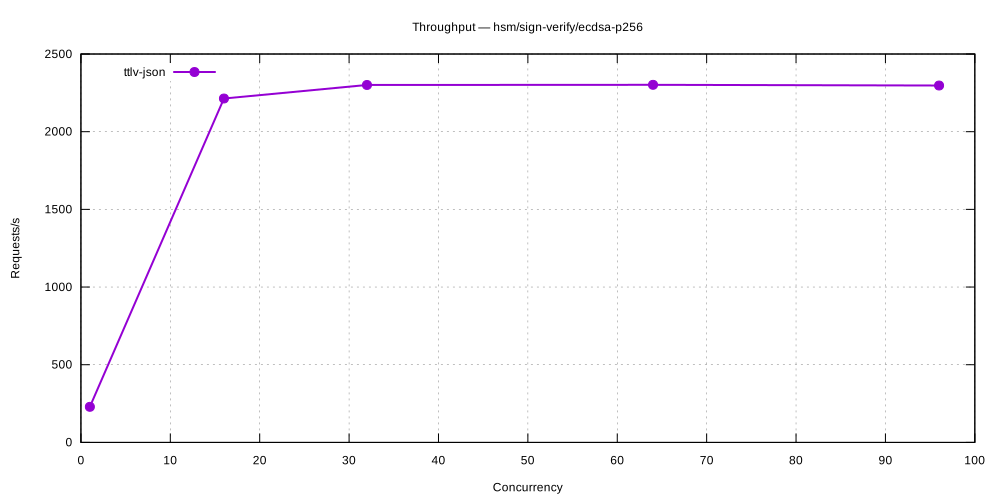
### hsm/sign-verify/ecdsa-p256
| Concurrency | ttlv-json (req/s) |
|---|---|
| 1 | 229 |
| 16 | 2,214 |
| 32 | 2,301 |
| 64 | 2,302 |
| 96 | 2,297 |
---